The Signs You Need Pest Control at Home, and What a Plan Looks Like in York, PA
Household insect problems announce themselves before they become visible. In south central Pennsylvania the calendar does much of the diagnostic work, because the same few species arrive at the same few moments every year.
Published Updated 10 min read
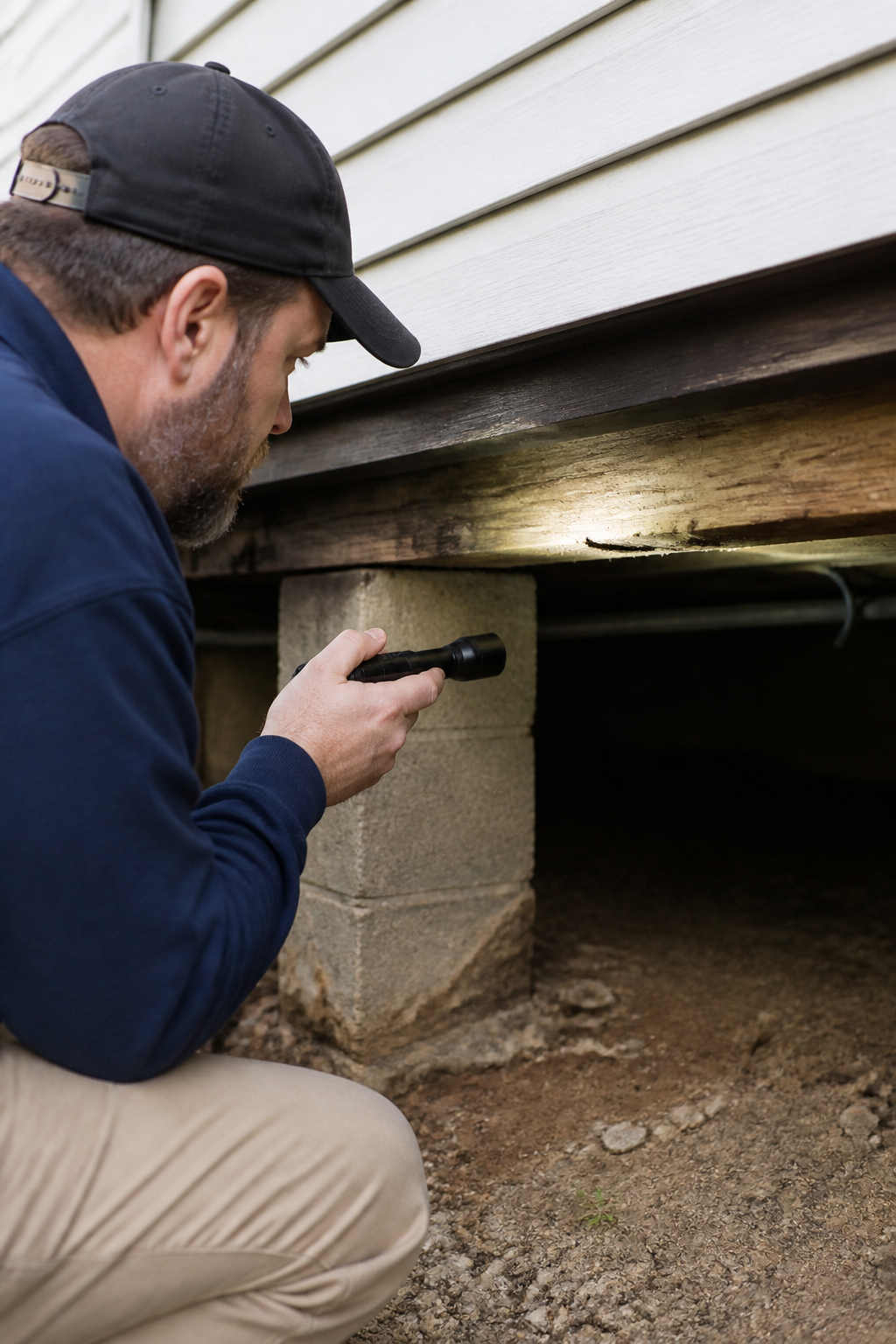
Almost nobody calls at the right moment. People call when they see an insect, which is late, or they spray something and call three weeks later, which is worse, because the evidence has been disturbed. The useful skill is reading the signs a house gives before there is anything to look at, and knowing which of them mean structure and which mean nuisance.
Read the signs, not the insect
- Shed wings on window sills, in spring. Small, equal-length, translucent wings in a pile is the classic termite or ant swarm sign, and it is usually the first one a homeowner ever sees.
- Mud tubes on foundation walls or piers. Pencil-width earth tunnels running up masonry are subterranean termites moving between soil and wood. Structural, not cosmetic.
- Frass. Fine sawdust-like material below timber, often with insect parts in it, points to carpenter ants or wood-boring beetles.
- Daytime sightings of a night insect. Cockroaches out in daylight usually means the harbourage is crowded, which means the population is larger than what you can see.
- A sweet, musty or oily smell in a kitchen or basement corner that does not come from food.
- Hollow-sounding or soft wood at a sill, a door frame near grade, or a deck ledger. Probe with a screwdriver, gently.
- Repeat sightings in one room. One insect is an accident. The same insect in the same room twice is a pathway.
The south central Pennsylvania calendar
York County sits in the humid continental band of the mid-Atlantic: cold winters, hot humid summers and a long shoulder season. That climate produces a fairly predictable annual pattern.
| Season | Usual arrivals | What to look at |
|---|---|---|
| Early spring | Subterranean termite swarms, carpenter ants becoming active | Window sills, foundation walls, damp timber near grade |
| Late spring and summer | Ant trails, wasp and hornet nests, mosquitoes | Standing water, soffits, deck framing, gutters holding debris |
| Late summer | Yellowjackets at their most aggressive, spiders indoors | Ground nests near paths, eaves, garage corners |
| Autumn | Brown marmorated stink bugs, cluster flies, rodents seeking warmth | South and west facing walls, attic vents, utility penetrations |
| Winter | Overwintering insects appearing indoors on warm days | Attics, wall voids, window frames |
Two of those have Pennsylvania in their history. The brown marmorated stink bug was first collected in the United States at Allentown, Pennsylvania in the late 1990s before spreading across the country, which is part of why the autumn wall-clustering behaviour is so familiar to households in this state. The spotted lanternfly was first detected in the United States in Berks County, Pennsylvania in 2014; it is a plant pest rather than a household one, but it congregates on decks, siding and outdoor furniture in late summer, and it is regulated, so what you do with infested material matters.
Termites: the one that is structural
The species that matters across Pennsylvania is the eastern subterranean termite, Reticulitermes flavipes. It nests in the soil and travels to wood through shelter tubes, which is why the evidence appears on foundation walls rather than in the open.
- Damage is slow and quiet, and it is hidden inside the timber, so what you can see always understates it.
- Any wood in contact with soil is an invitation: deck posts, fence rails against siding, firewood stacked at the wall, buried form boards left by the builder.
- Termite work is one of the few residential pest jobs where the diagnosis genuinely needs someone who does it every week, because the treatment strategy depends on construction type.
Ants leave sawdust. Termites eat it. If the tunnels are clean and packed with mud, stop guessing and get an identification.
Once the species is identified, the treatment is only half the job. The other half is the cleaning that removes what drew them in: food residue, grease films, damp organic matter in corners and behind appliances. That work follows its own rules, from the order in which surfaces are treated to the safe handling of disinfectants. A professional guide to cleaning and hygiene in premises covers those methods for teams and building managers. Applied at home, the same logic closes the gap between a pest treatment and a lasting result.
The distinction that changes the whole plan
Moisture is the real client
Most persistent insect problems in a house are moisture problems wearing a costume. Carpenter ants prefer wood that has been wet. Termites need soil contact and humidity. Cockroaches need water more urgently than food. Silverfish and springtails are effectively a humidity readout.
- Gutters that overflow, or downspouts discharging at the foundation.
- Ground that falls toward the house instead of away from it.
- A crawl space with an exposed earth floor and no vapour barrier.
- Mulch piled against siding, and firewood stacked against a wall.
- A slow leak under a sink or behind a dishwasher that nobody has looked for.
Correcting those conditions is not an alternative to treatment; it is what stops the treatment being an annual subscription. Several of them are covered from the water side in the guide to spending on a house in the right order.
What a competent treatment plan contains
- A written inspection. Where the inspector went, what they found, and what they could not access.
- An identification to species, not to family. Treatment for carpenter ants is not treatment for odorous house ants.
- A named product and a named target. The plan should say what is being applied, where, and why that site.
- Conditions to correct, written down, with the ones that are yours clearly separated from the ones they will handle.
- A follow-up date and a definition of success. Fewer sightings by when, and what happens if that does not occur.
- Preparation and re-entry instructions for the household, including pets.
A plan that is only a price and a frequency is not a plan. Ask for it before signing anything, not after.
The label is the law, and so is certification
In the United States, a pesticide label is a federally enforceable document. Applying a product in a way the label does not allow is not a shortcut, it is a violation, and it is also the usual reason a treatment fails.
Pennsylvania adds its own layer. Under the Pennsylvania Pesticide Control Act of 1973, administered by the Pennsylvania Department of Agriculture, commercial applicators must be certified in the categories they work in and businesses must be registered. Asking to see a certification, and which category it covers, is an ordinary question and a good filter.
What you can reasonably do yourself
| Situation | Reasonable to handle | Why |
|---|---|---|
| Occasional ants on a counter | Yes | Sanitation, sealing the trail entry, a labelled bait |
| Autumn stink bugs indoors | Yes | Exclusion and a vacuum; sprays achieve little |
| A single wasp nest in the open | Sometimes | Depends on height, access and whether anyone reacts to stings |
| Ground nesting yellowjackets on a path | No | Defensive in numbers, and the nest is not where the hole is |
| Any suspected termite evidence | No | Structural, and the treatment depends on construction detail |
| Cockroaches seen in daylight | No | Population is larger than it looks and needs a full plan |
The exclusion checklist
Exclusion is unglamorous and it outperforms almost everything else over a full year.
- Fit door sweeps on exterior doors, including the door from the garage into the house.
- Seal utility penetrations: hose bibs, dryer vents, cable and refrigerant lines, meter entries.
- Repair window and vent screens, and check attic and soffit vent screening.
- Keep mulch and soil back from siding, and keep siding clear of the ground.
- Store firewood off the ground and away from the wall.
- Cut back branches touching the roof, which are a bridge as much as a gutter problem.
The roof and the gutter line come up repeatedly on that list. If you are not sure what condition yours is in, the roof replacement guide sets out the signals that actually matter.
Insect work in York starts with the same question a homeowner asks about any repair: what is the smallest fix that holds? A French blog worth reading for home repairs answers that question for beginners, and it covers window insulation and no-knead bread alongside the basics. The guide library on this site keeps a page on a blog for beginners that lists what the blog holds for anyone keeping a house in order. Read it before you call a treatment service, so you know which gaps in the house are yours to close and which are not.