Why Tree Roots Damage Sewer Lines
Roots do not seek out pipes and they do not break into sound ones. They grow toward moisture and nutrients escaping through an existing defect, then thicken inside the pipe where nothing resists them. That distinction decides whether your repair lasts a season or thirty years.
Published 8 min read
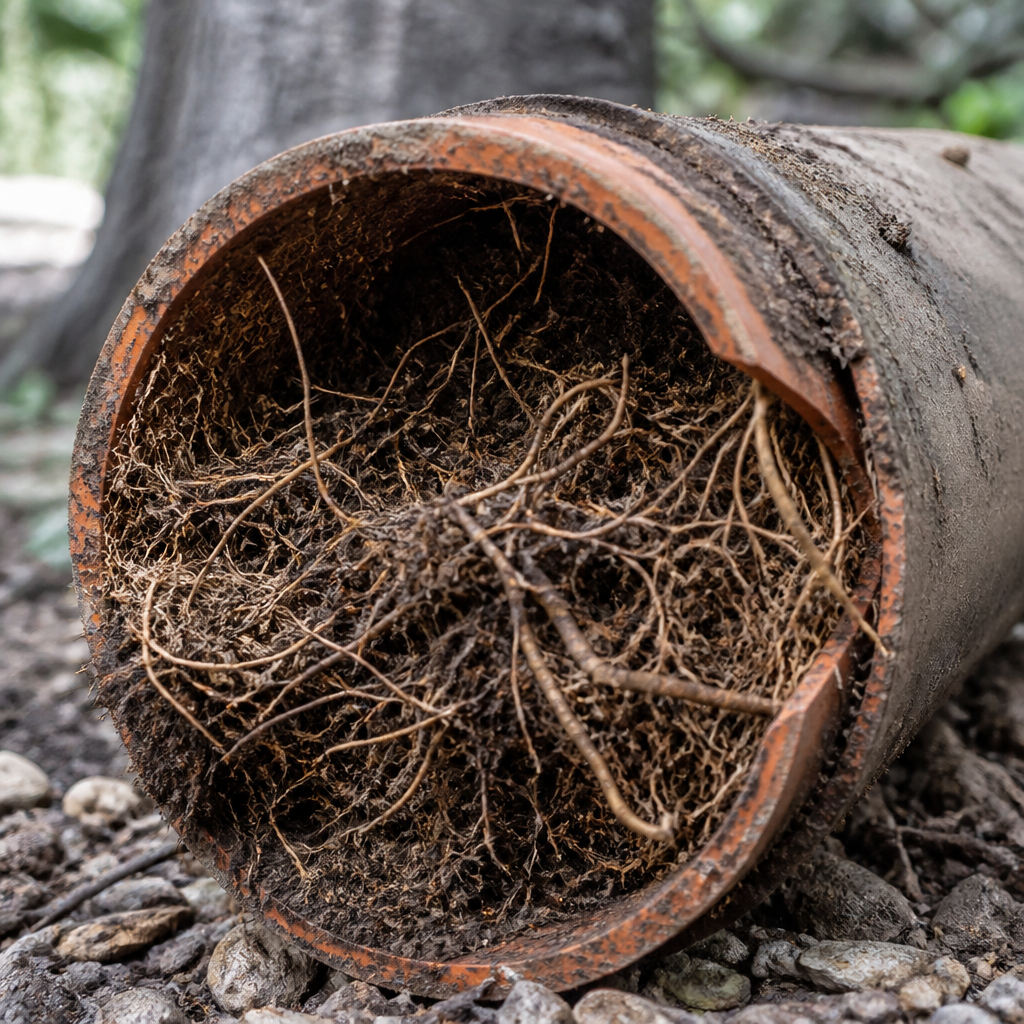
The common story is that a tree sends a root at a pipe and crushes it. That is not how it happens. A root grows where conditions are favourable and stops where they are not. A sewer lateral is warm, humid and nutrient rich, and if any of that is leaking out of a joint, the soil around that joint becomes the best real estate in the yard.
What roots are actually looking for
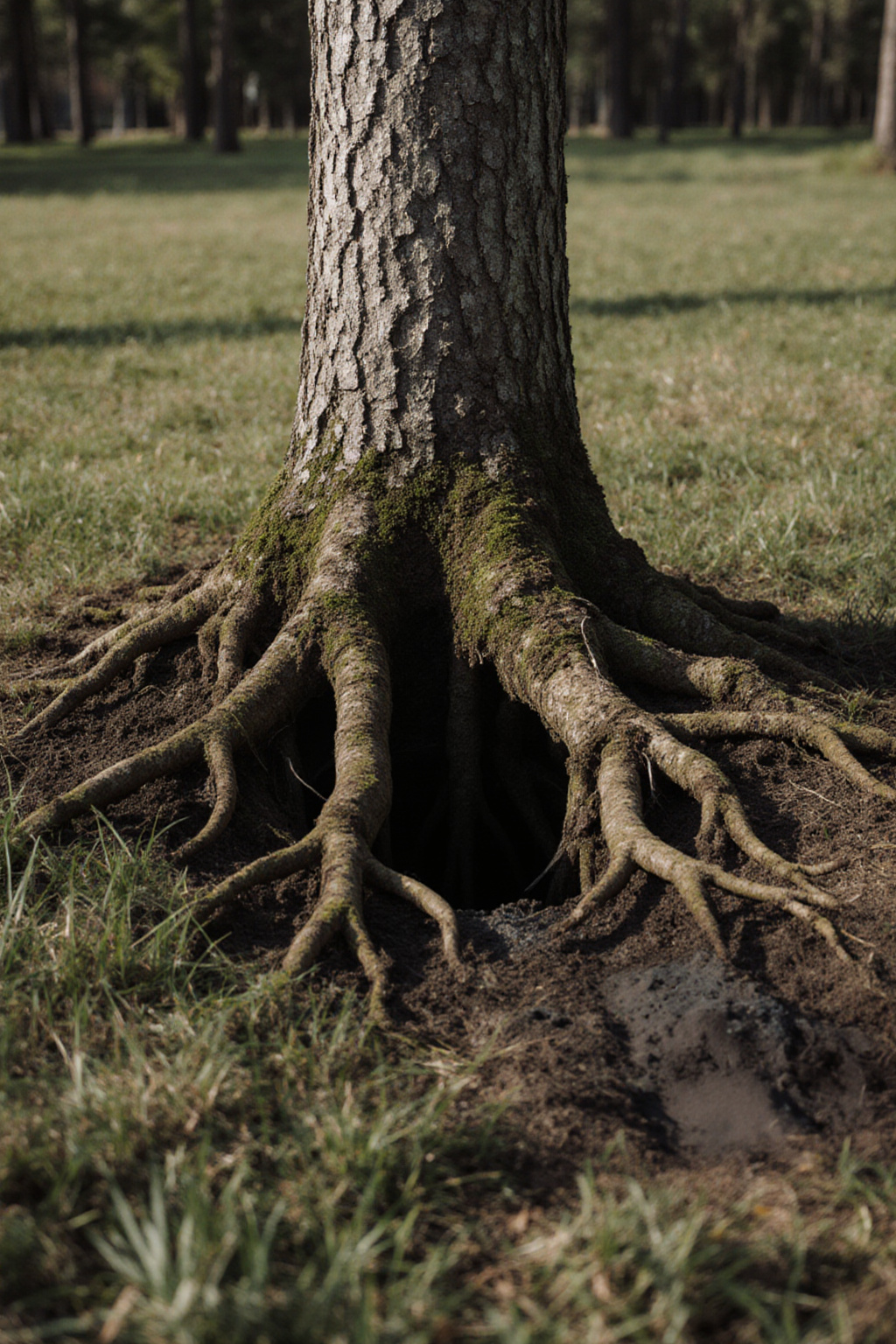
Water vapour and dissolved nutrients. A sound, sealed pipe leaks neither, so it presents nothing for a root to respond to. A pipe with an open joint, a hairline crack or a bad connection releases a plume of moist air into the surrounding soil, particularly in dry weather when the contrast with the rest of the ground is strongest.
Fine roots proliferate in that plume, find the gap, and pass through it as strands thin enough to go unnoticed. Once inside, they are in an environment with constant moisture, no competition and no mechanical resistance, and they thicken. It is the thickening that eventually splits a joint or lifts a section, so the damage people attribute to root force is usually the last chapter rather than the first.
Which pipes fail first
| Material | Why roots get in | Vulnerability |
|---|---|---|
| Vitrified clay tile | Short lengths with a hub joint every few feet, sealed with mortar or a gasket that ages | Highest: many joints, and joints are the entry point |
| Orangeburg (bituminised fibre) | Deforms and delaminates with age, losing its shape | High, and generally at the end of its life wherever it remains |
| Cast iron | Corrodes from the inside, and the hub joints open as the packing degrades | Moderate to high, depending on age and water chemistry |
| Concrete | Joint seals age, and the bore can be attacked in aggressive conditions | Moderate |
| PVC and ABS | Solvent welded or gasketed joints, long lengths, far fewer of them | Low, but not zero at fittings, connections and poorly bedded sections |
Knowing your material tells you a great deal before anyone puts a camera in the ground. A house from the era of clay tile laterals with a mature street tree is a very different proposition from a modern PVC lateral in a new subdivision.
How a blockage builds
- Fine roots enter at a joint and fan out inside the pipe, forming a net across the bore.
- The net catches paper, wipes, fats and grease, which is what turns a few strands into an obstruction.
- Flow slows, so solids that used to be carried along now settle upstream of the mass.
- The settled material narrows the pipe further, and each event happens sooner than the last.
- The blockage becomes complete, usually at the worst moment, because the trigger is high flow.
Roots do not block a sewer. Roots catch what you flush, and what you flush blocks the sewer.
Which is why the flushing rules matter more in an old lateral
Symptoms, in the order they appear
| What you notice | Likely stage | Sensible response |
|---|---|---|
| The lowest fixture in the house drains slowly | Partial restriction in the main run | Camera survey now, while it is cheap and dry |
| Gurgling from a floor drain or a toilet when a bath empties | Air being displaced past a restriction | Same, and stop treating it as a vent problem |
| A backup every few months, cleared each time | An established root mass being trimmed, not removed | Get a diagnosis rather than another cabling |
| Unusually green, fast growing grass along one line of the yard | Leakage feeding the soil above the defect | Locate the line, then survey it |
| A depression or a soft spot along the line | Soil migrating into a broken section | Structural, and no longer a cleaning question |
| Sewage backing into the lowest fixture | Full blockage | Emergency, then diagnosis once flow is restored |
Getting a real diagnosis
The pair of tools is a camera survey plus a locate. The survey shows the defects and their type; the locate puts them on the ground with a distance and a depth so any repair can be planned. Ask for footage counters in the video, a note of the pipe material and diameter, and the position of every branch connection. Keep the file. It is worth more to the next contractor than any description you can give them.
What each fix actually does
- Cabling and mechanical root cutting
- Cuts a channel through the mass. Flow returns immediately. The entry point is untouched and the roots regrow, so this is relief measured in months to a couple of years.
- Hydro jetting
- High pressure water scours the pipe wall far more thoroughly than a cable, and it removes grease as well as roots. Still leaves the defect. Worth doing before a camera survey so the survey shows the pipe rather than the debris.
- Root control foam
- A herbicidal foam applied by a licensed applicator, strictly according to the product label, that kills root tissue inside the pipe and slows regrowth. It manages the symptom on a schedule; it does not seal anything.
- Lining the pipe
- A cured in place liner covers the joints, which removes the entry points. This is the first option on the list that ends the mechanism rather than the episode.
- Spot repair or replacement
- Digging and replacing the defective section, or the whole lateral. The right answer where the pipe has lost shape, grade or continuity.
The comparison between lining and replacement, and the conditions under which lining is not possible, is set out in the pros and cons of trenchless sewer pipe replacement.
Planting distance and species
There is no universal safe distance, because it depends on species, soil, water availability and the condition of the pipe. The useful principles are simpler.
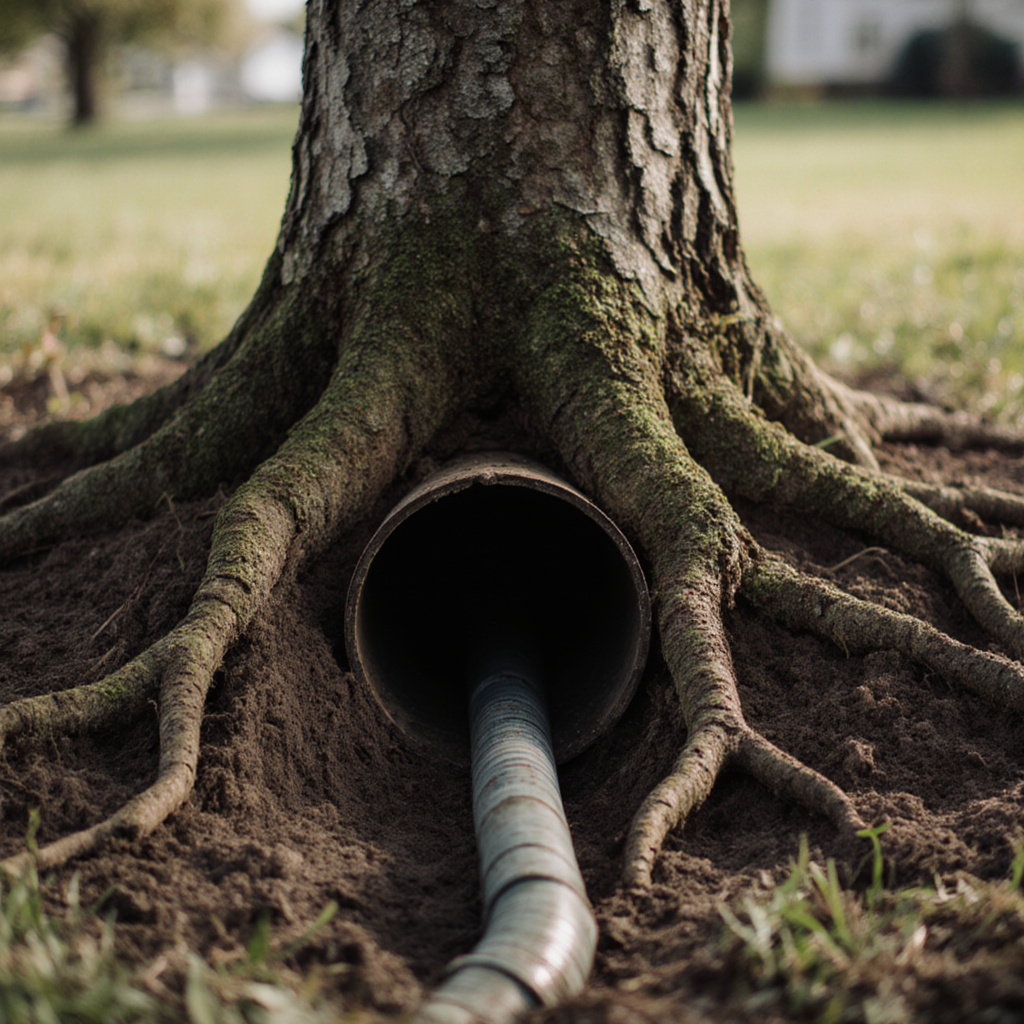
A root that reaches a cracked joint does not stop there. It follows water, and the pipe becomes a trellis. The repair is the same whether the tree is a maple or a willow: cut the intruding roots, sleeve or replace the damaged run, and decide what stays in the ground above it. That last decision is a planting decision, and it belongs with the rest of the yard plan. The guide food from the boundary hedge covers what to plant along a property line, what to leave standing, and what to read before you cut, so the hedge feeds the household instead of the drain.- Fast growing, water loving species cause most of the trouble: willows, poplars and cottonwoods, silver maple, elms, and several ornamental figs in warm regions.
- A root system commonly extends well beyond the canopy, so measuring from the trunk to the drip line understates the reach.
- Laterals usually run through the front yard toward the street, which is exactly where street trees are.
- Planting a large species near a known clay tile lateral is a decision about the next twenty years, not the next five.
- Root barriers help when installed correctly and at the right depth, and do very little when they are not.
The prevention that works
Fix the defect, not the roots. A pipe that does not leak does not recruit them. Everything else on the list, cutting, jetting, foaming, is maintenance of a condition you have chosen to keep.
Roots enter a sewer line for the same reason they enter anything else: water, oxygen, and a crack wide enough to admit a root tip. A clay joint that has shifted a quarter inch is enough. Once inside, the root mass thickens and catches paper and grease, and the line backs up. The repair is mechanical, but the planting above it is a choice. A dry garden with shallow, slow roots puts less pressure on buried pipe than a fast-growing tree does. For readers who want that kind of planting, the guide on growing Eriogonum from seed covers how to spot wild buckwheat on a hike and which species suit a small dry garden.Alongside that: keep fats and wipes out of the line, since they are what converts a root net into a blockage; get a camera survey before buying a house with mature trees and an old lateral; and if the ground above the line has settled, treat that as a structural signal rather than a landscaping one. The same settlement logic applies to paving, which is covered in the paver and hardscape guide.
Once the camera has confirmed where the roots have entered, the next decision is what to do about the pipe itself. The page on choosing a sewer repair method explains the two common approaches, CIPP lining and pipe bursting, both of which rebuild the lateral through two small pits instead of a long open trench. It also covers the cases where each method is ruled out, and the site conditions and access that drive the quote. Read it before you call anyone, so you know which questions to ask and which numbers to compare.